Inbox & API
Everything an operator needs ships in the gem — mount the engine (the installer does this) and it’s there. No dashboard to build, no second console to deploy.
The inbox — /silas/inbox
A session rail grouped Held / Working / Filed, web chat (start a session or reply from the browser — same durable loop), a live step-trace that streams tokens over Turbo as the agent runs, approval and question cards hoisted to the top of the session, a full audit trail (every tool call’s arguments and result, who cleared what and why), cancel, raise-budget, and per-session token/cost accounting priced from RubyLLM’s model registry.
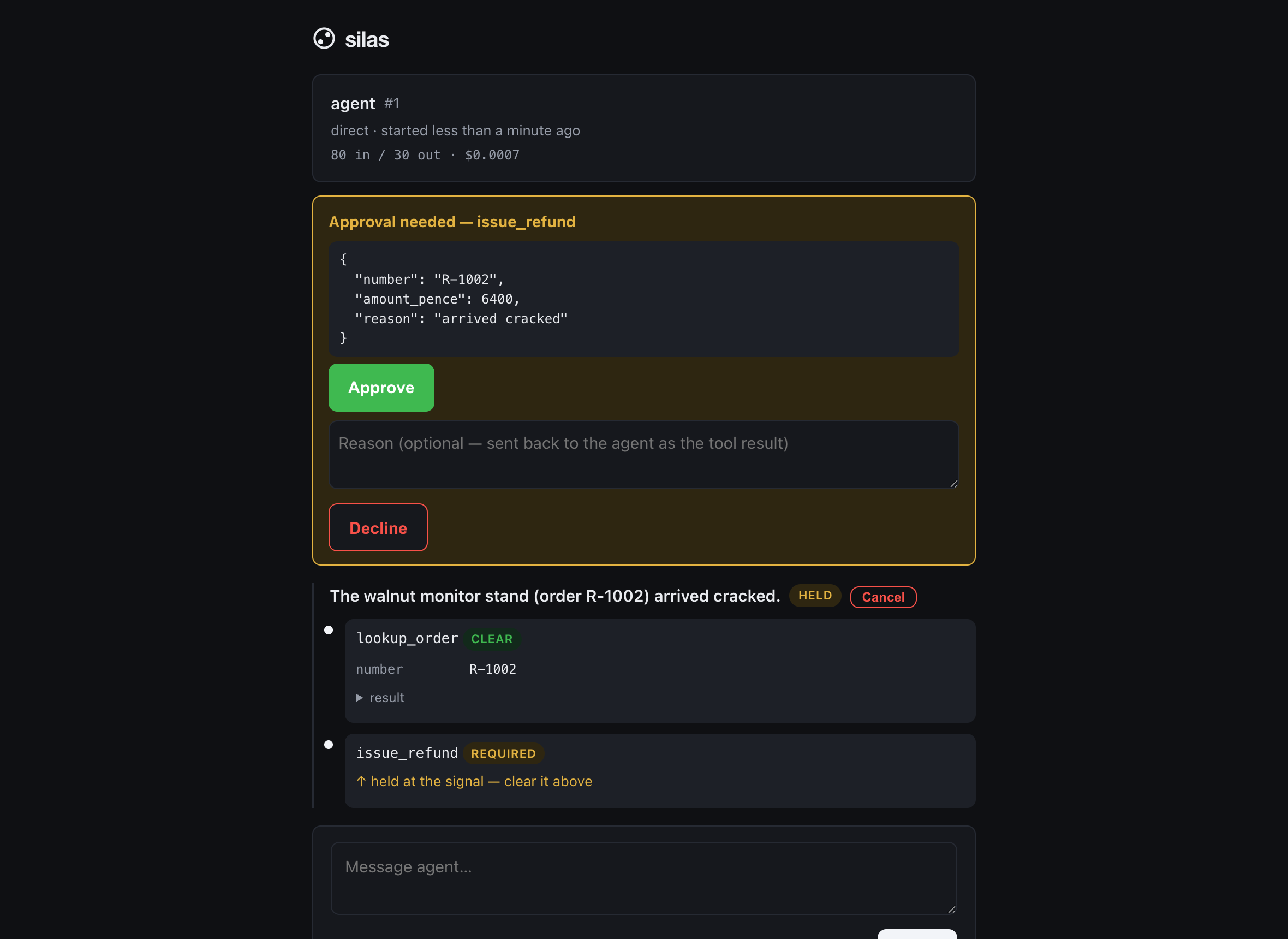
A £64 refund holding at the signal: the card carries the exact arguments, the turn costs nothing while it waits, and the trace below keeps a one-line stub where the invocation held.
It’s deny-by-default — invisible until you wire auth:
Silas.configure do |c|
  # The lambda DENIES by rendering (or head-ing) and PASSES by not rendering.
  c.inbox_auth = ->(controller) { controller.head :not_found unless controller.current_user&.admin? }
  # c.inbox_public_read = true   # read-only demo mode; writes stay gated
  # c.model_prices["your-fine-tune"] = { in: 3000, out: 15_000 }  # price overrides
end
config.inbox_actor names the identity recorded on approvals (defaults to
current_user&.email || "inbox"). Live streaming activates automatically when
the host app has turbo-rails (every default Rails app does); without it the
trace falls back to a polling refresh. The gem takes no turbo dependency.
The JSON API — /silas/api/v1
The same surface over HTTP, also deny-by-default (config.api_auth, same
contract as the inbox; config.api_actor names the API identity):
curl -X POST .../silas/api/v1/sessions -d "input=Refund order 42, £12.50"
curl .../silas/api/v1/sessions/1?trace=1                # turns + steps + tool calls
curl .../silas/api/v1/sessions/1/approvals              # what's held
curl -X POST .../silas/api/v1/approvals/7/approve       # the same approve! as the inbox
curl -X POST .../silas/api/v1/approvals/9/answer -d "answer=Use the June invoice"
curl -X POST .../silas/api/v1/sessions/1/turns -d "input=Now email them"   # 409 if busy
curl -X POST .../silas/api/v1/turns/9/cancel
curl -N .../silas/api/v1/sessions/1/stream              # server-sent events
The stream is SSE at row granularity — turn, completed-step, and
invocation changes, at-least-once with Last-Event-ID resume (ids are
epoch-ms watermarks). ?poll=1 returns the backlog and closes, curl-friendly;
streams close themselves after config.api_stream_max_duration and clients
reconnect. Per-token streaming is deliberately the browser/Turbo feature:
deltas live in the worker process, and the gem requires no cross-process bus.
Streaming — decoration over durable rows
Turns stream everywhere it helps: silas:chat prints tokens as they arrive,
and the inbox renders them live (coalesced to ~10Hz). Deltas are never
persisted, never fed back to the model, and absent from replays — a replayed
step renders from its row — so streaming adds zero risk to the durability
contract. Custom sinks subscribe to the "delta.silas" notification
({ session_id:, turn_id:, step_id:, step_index:, text: }, where text is
the accumulated string so far; filter by ids — notifications are
process-global).
Structured answers
Give the turn’s final answer a schema in agent.yml:
final_answer:
  type: object
  properties:
    verdict: { type: string }
    amount_pence: { type: integer }
  required: [verdict]
Turn#answer_data returns the parsed Hash (answer_text stays for prose
agents); the API carries it as answer_data, and evals assert on it with
assert_answer_data(key: :verdict, value: "approve"). Rendered through
RubyLLM’s with_schema, so each provider’s native structured-output mode is
used. The schema is model-visible state — changing it mid-turn fails the turn
loudly rather than resuming into a different contract.